Semax
Synthetic ACTH(4-10) analog · 7-residue peptide
813.92 g/mol · C₃₇H₅₁N₉O₁₀S · Sequence MEHFPGP
A synthetic seven-residue peptide developed in Russia in the 1980s as an analog of the ACTH(4-10) fragment, with a Pro-Gly-Pro extension at the C-terminus. Sold for in vitro laboratory research and analytical use only.
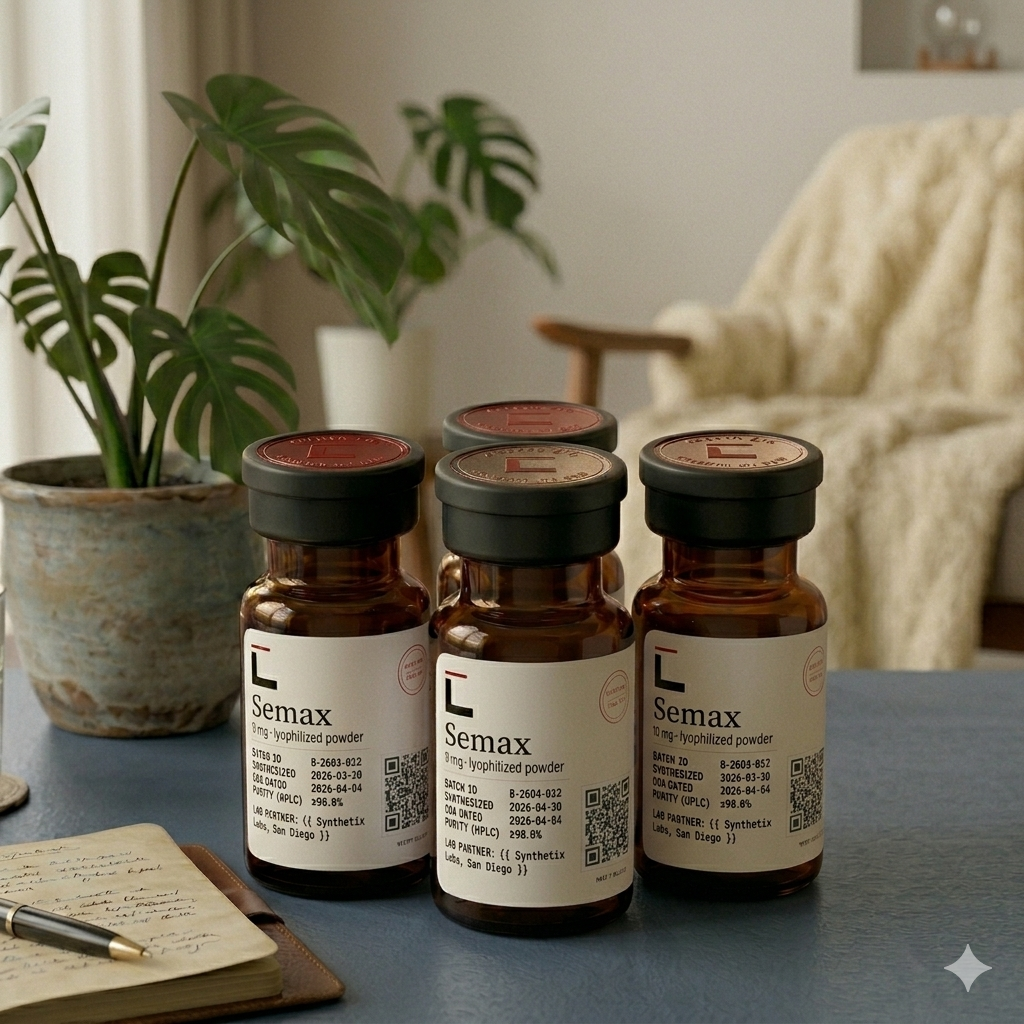
An ACTH(4-10) analog with a Pro-Gly-Pro extension.
Semax is a synthetic heptapeptide (Met-Glu-His-Phe-Pro-Gly-Pro) developed at the Institute of Molecular Genetics of the Russian Academy of Sciences during the 1980s and 1990s. Its structure begins with the ACTH(4-10) core fragment — a sequence identified in earlier pharmacological research as carrying behavioral and cognitive activity in animal models independent of adrenocortical steroid production. The C-terminal Pro-Gly-Pro extension was added to slow enzymatic degradation; Semax is substantially more resistant to peptidase cleavage than the parent ACTH(4-10) sequence, improving stability in biological fluids and extending its effective research window in in vitro and in vivo experiments.
Semax engages melanocortin receptors, particularly MC4R and MC5R — the subtypes most associated with central nervous system effects. This binding profile is shared with the ACTH(4-10) parent sequence but not with the full-length ACTH molecule, which carries separate adrenocortical activity through MC2R. Beyond direct receptor engagement, published cell-biology research has focused on effects on neurotrophic factor expression: upregulation of BDNF and NGF has been observed in neuronal cell lines, primary neuronal culture, and animal brain tissue across multiple independent publications.
The animal-model literature covers cognitive endpoints (learning and memory tasks in rodent paradigms), neuroprotective endpoints (stroke and ischemia models), and some inflammation-related readouts in CNS tissue. Dose-response relationships have been documented across a range of administration routes, including intranasal delivery, which is notable because many peptides are not CNS-active via that route. The mechanism by which intranasal Semax reaches the CNS is a subject of ongoing investigation.
Clinical research on Semax exists, but the evidence base requires careful interpretation. A substantial portion of the clinical work was conducted in Russia and published in Russian-language journals — some indexed by major international databases, others not. The indication areas investigated include ischemic stroke, optic nerve lesions, and cognitive endpoints in healthy subjects and patient populations. Much of this research predates modern clinical trial registration requirements, and study designs vary considerably in rigor and reporting completeness.
Researchers reading the Semax literature should maintain awareness of the bibliographic split. Searching only English-language databases will miss a significant portion of the foundational research. Working with translated Russian-language primary papers — and applying the same critical appraisal standards used for English-language publications — gives a more complete and more accurate picture of what has been investigated, what has been replicated, and what remains uncertain.
Identity and storage.
| Compound | Semax (Met-Glu-His-Phe-Pro-Gly-Pro) |
| Molecular formula | C37H51N9O10S |
| Molecular weight | 813.92 g/mol |
| Sequence (one-letter) | MEHFPGP |
| Form | Lyophilized white powder |
| Purity (HPLC) | ≥98.0% |
| Storage (sealed) | -20°C, dry, dark |
| Storage (reconstituted) | 4°C, ≤30 days |
| Reconstitution solvent | Bacteriostatic water or saline |
Every Semax batch we have shipped.
Reverse chronological. Nothing deleted.
| Batch ID | COA date | Purity | Notes | Document |
|---|---|---|---|---|
| B-2602-019 | 2026-02-25 | ≥98.4% | — | [PDF] |
| B-2601-008 | 2026-01-20 | ≥98.0% | — | [PDF] |
See destroyed batches on the transparency log →
Research-use-only disclosure.
Foundational literature.
- Ashmarin I.P. et al. (1997). Semax, an analog of ACTH(4-10) with a broad spectrum of nootropic and neuroprotective properties. Russian Journal of Bioorganic Chemistry, 23(1):23–30.
- Dolotov O.V. et al. (2006). Semax, an analogue of ACTH(4-10), regulates BDNF and trkB expression in the rat hippocampus. Journal of Molecular Neuroscience, 28(2):185–200.
- Medvedeva E.V. et al. (2014). The peptide semax affects the expression of genes related to the immune and vascular systems in rat brain focal ischemia. BMC Neuroscience, 15:108.