GHK-Cu
Glycyl-L-histidyl-L-lysine copper complex
340.84 g/mol (peptide) · Cu²⁺ complex · Sequence GHK
A naturally-occurring tripeptide bound to a copper(II) ion. Sold for in vitro laboratory research and analytical use only.
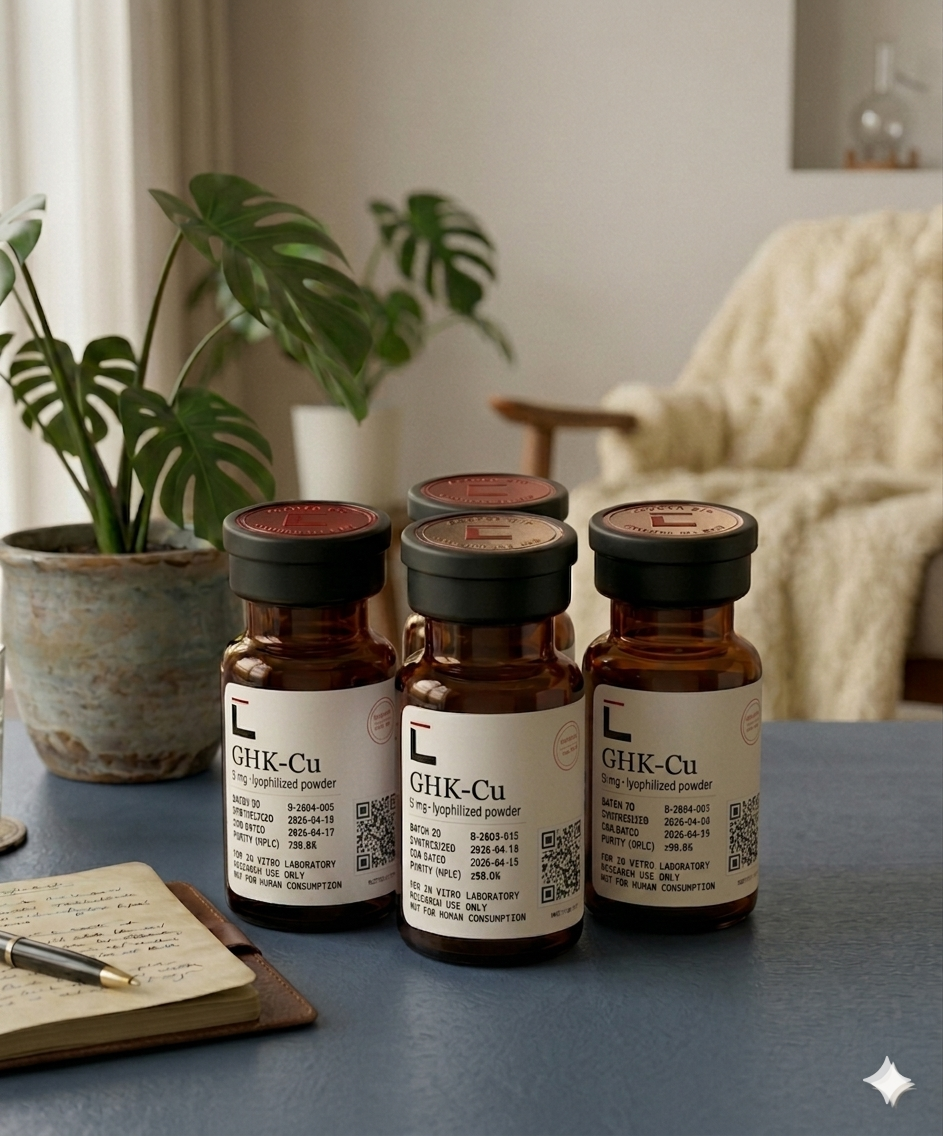
An endogenous human tripeptide bound to copper(II).
GHK-Cu (glycyl-L-histidyl-L-lysine copper(II)) is a small endogenous tripeptide first isolated from human plasma albumin in the 1970s by Loren Pickart, who identified it as a fragment that promoted hepatocyte growth and protein synthesis in culture. GHK binds copper(II) ions with high affinity — dissociation constant in the femtomolar range — and is found predominantly in the copper-bound form under physiological conditions. It is also present in saliva, urine, and tissue fluid at detectable concentrations.
Plasma GHK concentrations decline substantially with age — from roughly 200 ng/mL in young adults to approximately 80 ng/mL in older adults. This age-related decline has been cited in the context of research on wound healing capacity and skin aging, though the biological significance of circulating levels versus locally synthesized or topically applied peptide remains incompletely characterized in the literature.
The mechanistic focus of most published in vitro research is on copper-mediated stimulation of extracellular matrix synthesis. Studies in fibroblast and keratinocyte culture have reported increased production of collagen types I and III, fibronectin, glycosaminoglycans, and small proteoglycans. Antioxidant activity has also been documented, including upregulation of superoxide dismutase and inhibition of iron-catalyzed lipid peroxidation. Pickart's group later conducted microarray analyses suggesting GHK-Cu modulates the expression of several hundred genes — including clusters associated with collagen remodeling, anti-inflammatory signaling, and anti-apoptotic pathways — a finding that has generated significant interest but also methodological scrutiny regarding normalization and cell-line specificity.
Animal-model wound healing studies have generally shown accelerated wound closure and improved skin tensile strength. Dermal fibroblast contraction assays, neovascularization endpoints, and hair follicle stimulation models have all appeared in the preclinical literature across multiple independent groups. The cosmetic research literature is expansive but should be evaluated separately from the peer-reviewed mechanistic work — the two bodies of evidence have different methodological standards and different purposes.
Well-controlled human clinical data is more limited than the in vitro and animal work. The most rigorous human studies are in cosmetic dermatology, examining topical GHK-Cu formulations for markers of photoaged skin. These studies provide useful information on penetration and tolerability but do not directly characterize the mechanisms that are the primary subject of cell-culture investigation. Researchers should match their experimental questions to the appropriate tier of the existing literature.
Identity and storage.
| Compound | GHK-Cu (Tripeptide-1 + Cu²⁺) |
| Molecular weight | 340.84 g/mol (peptide); 403.89 g/mol with Cu²⁺ |
| Sequence (one-letter) | GHK |
| Form | Lyophilized blue powder (copper complex) |
| Purity (HPLC) | ≥98.0% |
| Storage (sealed) | -20°C, dry, dark |
| Storage (reconstituted) | 4°C, ≤30 days |
| Reconstitution solvent | Sterile water; protect from light |
Every GHK-Cu batch we have shipped.
Reverse chronological. Nothing deleted.
| Batch ID | COA date | Purity | Notes | Document |
|---|---|---|---|---|
| B-2603-011 | 2026-03-15 | ≥98.3% | — | [PDF] |
| B-2602-006 | 2026-02-08 | ≥98.0% | — | [PDF] |
See destroyed batches on the transparency log →
Research-use-only disclosure.
Foundational literature.
- Pickart L. (1973). Human plasma fractions with growth-promoting activity on cultured normal fetal lung cells and their similarity to other serum factors that affect growth. Journal of Cell Biology, 57(1):27–37.
- Pickart L. & Margolina A. (2018). Regenerative and protective actions of the GHK-Cu peptide in the light of the new gene data. International Journal of Molecular Sciences, 19(7):1987.
- Gorouhi F. & Maibach H.I. (2009). Role of topical peptides in preventing or treating aged skin. International Journal of Cosmetic Science, 31(5):327–345.