BPC-157
Body Protection Compound · 15-residue peptide
1419.55 g/mol · C₆₂H₉₈N₁₆O₂₂ · Sequence GEPPPGKPADDAGLV
A fifteen-residue synthetic peptide whose sequence corresponds to a fragment of a larger protein originally isolated from human gastric juice. Sold for in vitro laboratory research and analytical use only.
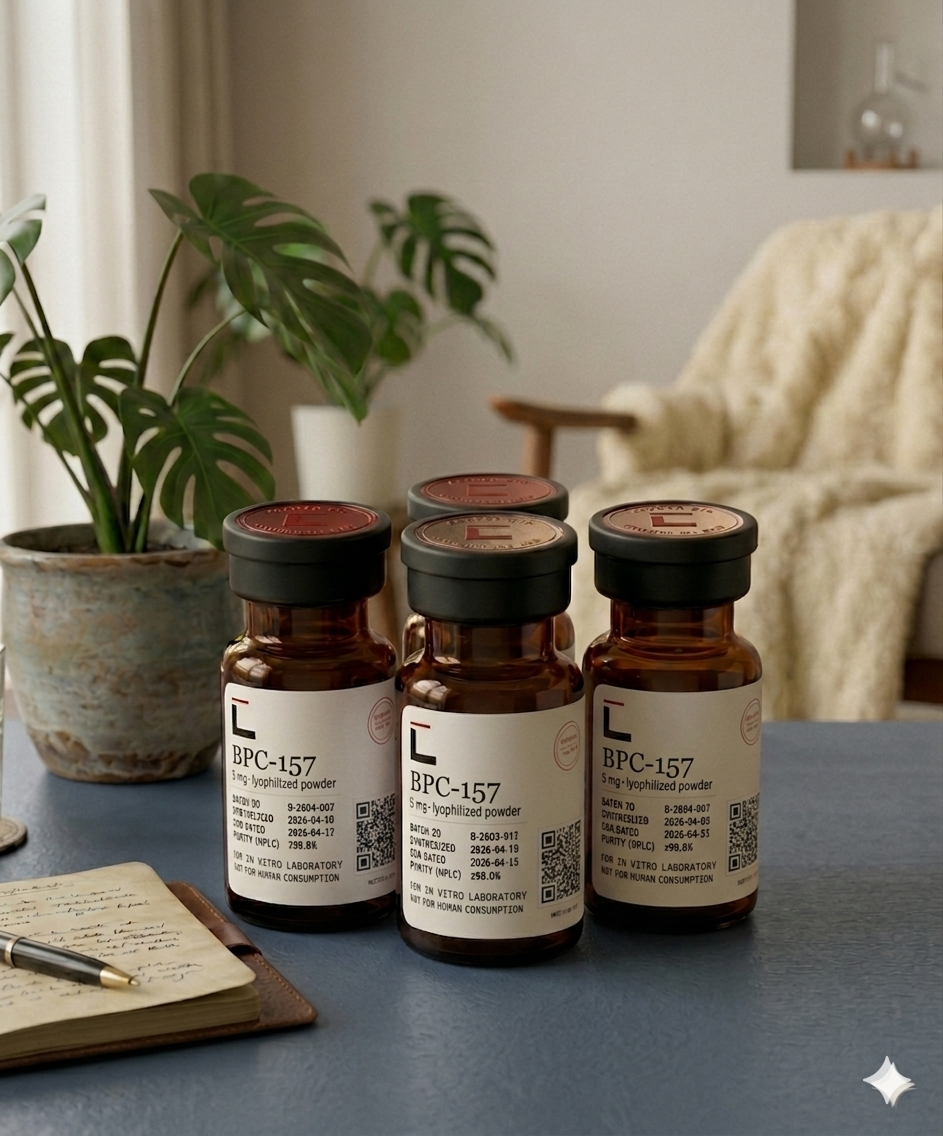
A synthetic fragment of a larger gastric protein.
BPC-157 is a synthetic 15-amino-acid pentadecapeptide whose sequence corresponds to a fragment of a larger protein originally isolated from human gastric juice. The parent protein was named body protection compound — BPC — by the Croatian research group that first characterized it in the early 1990s. BPC-157 is the stable, defined fragment that became the standard subject of published laboratory investigation.
The published research base on BPC-157 is overwhelmingly preclinical — primarily in vitro experiments and rodent animal studies. Investigators have studied the peptide's effects on tissue repair, gastrointestinal mucosa, tendon and ligament healing, and angiogenic activity in cell-culture and animal-model contexts. Human clinical research is limited and consists largely of small early-phase studies.
Mechanistically, BPC-157 research has examined several proposed signaling axes. Studies in cell culture have looked at effects on fibroblast migration and proliferation, nitric oxide synthesis, and interactions with growth hormone receptor pathways. Angiogenic endpoints — including tube formation assays and VEGF-pathway readouts — appear frequently in the in vitro literature. These are active areas of preclinical investigation; none represent mechanisms characterized to the level of validated therapeutic targets.
The gastrointestinal mucosa literature is one of the most developed areas. A substantial body of rodent research has examined BPC-157 in models of gastric lesion, colitis, and intestinal anastomosis healing. These studies are mechanistically detailed and internally consistent across multiple independent groups, though the translational questions to human GI tissue remain open.
The tendon and ligament literature is similarly well-represented, with animal-model studies examining healing outcomes in transection models of the Achilles, medial collateral, and other connective tissues. Fibroblast-based in vitro work generally supports the in vivo observations, though dose-response characterization varies across studies and the field lacks a single agreed-upon model system.
Researchers should read the primary literature — not review articles — before designing experiments. Review quality in this space varies considerably, and secondary sources frequently overstate the strength of available evidence. The preclinical record is real and substantial; the human trial data is not.
Identity and storage.
| Molecular formula | C62H98N16O22 |
| Molecular weight | 1419.55 g/mol |
| Sequence (one-letter) | GEPPPGKPADDAGLV |
| Form | Lyophilized white powder |
| Purity (HPLC) | ≥98.0% |
| Storage (sealed) | -20°C, dry, dark |
| Storage (reconstituted) | 4°C, ≤30 days |
| Reconstitution solvent | Bacteriostatic water |
Every BPC-157 batch we have shipped.
Reverse chronological. Nothing deleted. Consistency is a trust signal too.
| Batch ID | COA date | Purity | Notes | Document |
|---|---|---|---|---|
| B-2603-018 | 2026-03-22 | ≥98.0% | — | [PDF] |
| B-2603-004 | 2026-03-03 | ≥97.8% | — | [PDF] |
| B-2602-009 | 2026-02-11 | ≥98.2% | — | [PDF] |
See destroyed batches on the transparency log →
Research-use-only disclosure.
Foundational literature.
A short, linkable list of the published work most relevant to interpreting BPC-157 research. We do not paraphrase results. We do not editorialize.
- Sikiric P. et al. (1993). The pentadecapeptide BPC 157 increases glutathione and serotonin in rat stomach. Digestive Diseases and Sciences, 38(9):1713–1720.
- Chang C.H. et al. (2011). The promoting effect of pentadecapeptide BPC 157 on tendon healing involves tendon outgrowth, cell survival, and cell migration. Journal of Applied Physiology, 110(3):774–780.
- Sikiric P. et al. (2016). Stable Gastric Pentadecapeptide BPC 157 — Novel Therapy in Gastrointestinal Tract. Current Pharmaceutical Design, 17(16):1612–1632.
- Seiwerth S. et al. (2014). BPC 157 and Standard Angiogenic Growth Factors — Gastrointestinal Tract Healing, Lessons from Tendon, Ligament, Muscle and Bone Healing. Current Pharmaceutical Design, 20(7):1121–1125.